

Speech Therapy: More Than Just Sounds
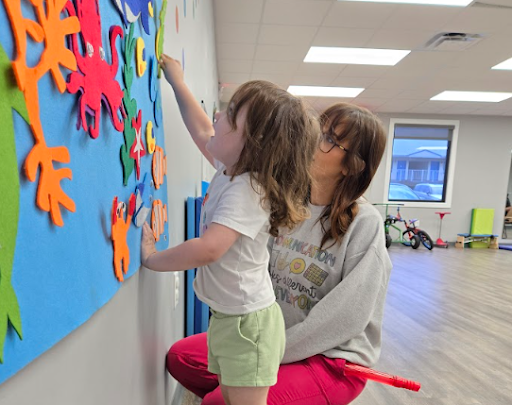
Most people know that speech-language pathologists help kids articulate sounds in words. They turn “wight” into “right,” “tat” into “cat,” and fix stubborn lisps.
However, speech sounds are only a small part of a speech-language pathologist’s scope of practice! Here is a quick overview of how our speech-language pathologists are equipped to serve the kids in our community!
Speech Production
Motor Planning and Execution
The process of speech seems simple when everything goes right, but there’s actually a lot that has to happen to allow thoughts in your head to become spoken words. Motor centers in your brain send signals to the parts of your body that produce speech with instructions for breath support, voicing, and movement of the tongue, lips, jaw, and soft palate. Sometimes, the planning process breaks down, making speech attempts appear uncoordinated (apraxia). In other cases, the muscles that produce speech lack the strength or range of motion necessary for speech production (dysarthria).
Signs of Motor Speech Disorders:
- A strained or quiet voice
- Sound distortions
- Inconsistent speech errors
- Slow speech
- Visibly struggling when trying to produce speech
- Difficulty producing multisyllabic words
Phonology
Phonological speech disorders result from difficulty with the speech sound system of language, or the “rules” of how sounds are organized in words. Children with phonological disorders often consistently substitute one sound for another, like using /w/ in place of /l/ and /r/ or /t/ in place of /k/. These sound substitutions are a normal part of speech development, but when they persist beyond their expected age of elimination, a speech-language pathologist can help.
Common Phonological Error Patterns Include:
- Gliding: Replacing /r/ or /l/ with /w/ or /y/ (e.g., wed/red)
- Stopping: Replacing a continuant sound like /s/, /z/, /f/, or /v/ with stop sounds like /t/, /d/, /p/, or /b/ (e.g., tay/say)
- Fronting: Replacing “back” sounds with “front” sounds (e.g., tat/cat)
- Consonant Cluster Reduction: Omitting sounds in consonant clusters (e.g., top/stop)
- Vowelization: Replacing vocalic /r/ or /l/ with vowel sounds (e.g., sto-u/store)
- Final Consonant Deletion: Leaving off final sounds (e.g., bo/boat)
Articulation
Articulation disorders result from a motor-based difficulty in producing a specific speech sound and will result in consistent speech sound errors. Examples include sound distortions like frontal or lateral lisps or consistent sound substitutions limited to a small number of sounds.
Fluency
Stuttering
Stuttering is an interruption in the flow of speech due to disfluencies, often affecting the rate and rhythm of speech.
Signs of stuttering include:
- Sound, syllable, word, or phrase repetitions
- Prolongations (stretching out a sound or syllable)
- Blocks (becoming stuck during a word, often with physical tension)
Cluttering
Cluttering is characterized by an abnormally rapid or irregular rate of speech, frequent interjections (e.g., um) and revisions (changing word/phrase after beginning it), as well as slurred speech or sounds and syllables that run together. Children exhibiting cluttering often have limited awareness of their speech disturbances.
Language
Language disorders encompass difficulties with comprehension and use of language, in both oral and written modalities.
Components of language include:
- Phonology—the sound system of language. Difficulties in phonology may result in speech sound errors or deficits in phonological awareness. Children with phonological awareness deficits demonstrate difficulty identifying the sounds in words, rhyming, and blending sounds and may struggle with early reading and spelling instruction.
- Morphology—the smallest units of language that convey meaning. For instance, the word “dogs” has two morphemes: “dog” and the plural “-s.” Children with morphological deficits may struggle with verb tenses, pronouns and function words, and suffixes and prefixes.
- Semantics—the meaning of language. Children with poor vocabularies struggle with semantic skills. Semantics also incorporates how words combine to form meaning in sentences and passages. Children who struggle with nonliteral language also display deficits in the area of semantics.
- Syntax—the structure of sentences. Children with syntax errors may use shorter, simpler sentences and display errors related to word relationships, like subject-verb agreement (e.g., I goes vs. I go).
- Pragmatics—the use of language, or social language. Children with social language difficulties may need help using language for different purposes (greeting, informing, requesting, etc.), changing language to fit the listener or situation (communicating differently with friend vs. teacher, giving background information when needed, etc.), or following conversation rules (staying on topic, taking turns, using and understanding body language, etc.).
Written Language Disorders
As language experts, speech-language pathologists treat written language disorders as well. These include:
- Dyslexia
- Reading comprehension deficits
- Difficulties with written language expression or composition
Language Modalities
Speech-language pathologists help children find and use the most functional form of communication for their individual needs. This may include:
- Spoken language
- Augmentative and alternative communication: speech generating devices, American Sign Language, communication boards, gestures, and more!
Voice and Resonance
Speech-language pathologists support vocal quality and vocal health. Voice and resonance problems may result from disorders such as cerebral palsy or muscular dystrophy, injuries such as traumatic brain injury, structural anomalies like cleft palate, or simply over-use.
Signs of voice and resonance disorders include:
- Strained, raspy, hoarse, or breathy vocal quality
- Fatigue while speaking
- Inappropriate pitch or reduced pitch range
- Reduced or excessive volume
- Hypernasal or hyponasal speech
Cognition
Speech-language pathologists are integral team members for children facing cognitive deficits due to developmental delays, disorders, or injuries.
Speech therapists are trained to address:
- Executive functioning skills: planning, organizing, self-monitoring and regulation
- Memory and recall
- Attention
- Information processing
- Problem solving
Feeding and Swallowing
Many people are surprised to learn that speech-language pathologists are experts in feeding and swallowing! Because many of the same structures involved in speech production are also involved in the feeding and swallowing process, a speech therapist’s graduate education includes training in identification and treatment of feeding and swallowing disorders.
Signs that a child would benefit from a feeding and swallowing evaluation include:
- Unexplained poor weight gain
- Coughing, choking, or gagging during meals
- Excessive drooling or food leaking from the mouth
- Congestion or watery eyes immediately after eating
- Hoarse or breathy voice after eating
- Food avoidance or extreme pickiness
Auditory Habilitation/Rehabilitation
In conjunction with an audiologist and an appropriate medical team, speech-language pathologists provide services for children with speech and language disorders resulting from hearing loss or deafness, as well as auditory processing skills.
We have immediate openings for speech and language evaluations! If you are concerned about your child’s development in one or more of these areas, call us today at 660-219-9176 (Clinton) or 660-219-9381 (Knob Noster).
Questions or comments? Reply to this email!
Written By: Amy Wolcott M.S., CCC-SLP