
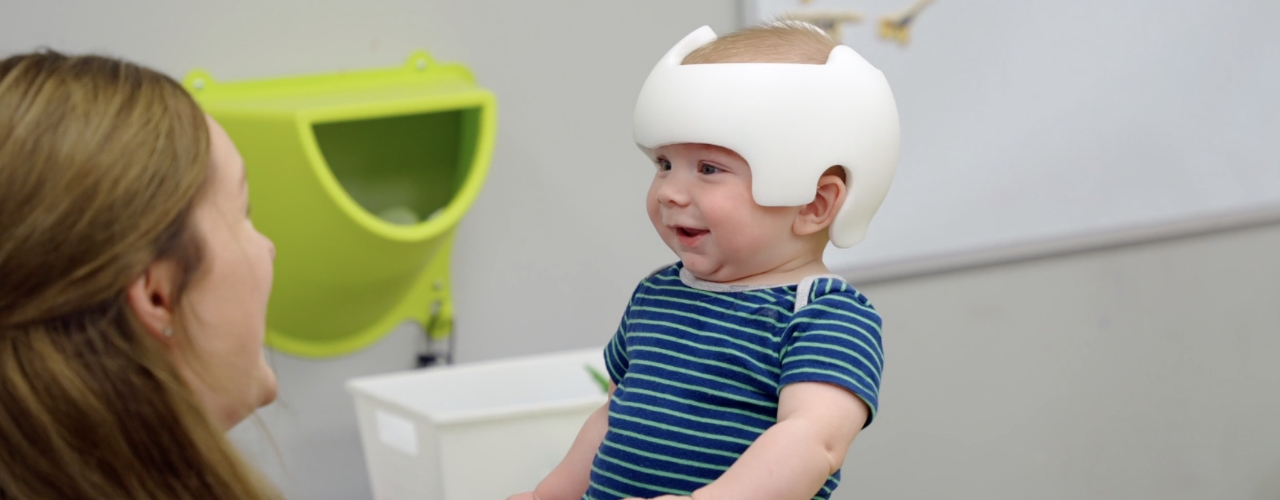
Torticollis in Infants and Children
Supporting Their Healthy Development
Torticollis, a condition causing the head to tilt and twist to one side, can be a significant concern for parents. Our pediatric physical therapists offer a holistic and patient-centered approach to address torticollis and promote healthy development in infants and children.
At The Pediatric Place, we understand that even minor physical limitations can impact a child’s development, and we do our best to guide you and your child to the best possible outcomes!
Understanding Torticollis in Children
Torticollis occurs when the neck muscles tighten on one side, causing the head to tilt and the chin to rotate to the opposite side.
There are two main types of torticollis:
Congenital Muscular Torticollis:
The most common type present at birth due to tight or shortened sternocleidomastoid (SCM) muscles on one side of the neck.
Acquired Torticollis:
Develops later in infancy or childhood due to injury, infection, or other medical conditions.
Evidence-Based Approach to Torticollis
Our patient-centered care goes beyond just stretching the tight muscles. We consider:
Sensory Processing:
How your child processes sensory information, such as touch and movement, which can influence their head position.
Postural Development:
Promoting proper head and body alignment to prevent further complications.
Emotional Well-being:
Addressing any discomfort or frustration your child may experience due to torticollis.
Feeding Skills
Torticollis can significantly impact feeding, as babies need proper head and neck alignment to feed effectively.
Physical Therapy for Torticollis
Our physical therapists will work with you and your child to develop a personalized treatment plan. This plan may include:
- Gentle Stretching Exercises: We will teach you safe and effective stretches to lengthen the shortened neck muscle, improving head mobility.
- Positioning Techniques: Strategies for positioning your child during sleep, feeding, and playtime to encourage proper head and neck alignment.
- Sensory Integration Activities: Activities that address your child’s sensory sensitivities, promoting improved comfort and participation.
- Parental Education: We equip you with the knowledge and skills to continue your child’s treatment at home, ensuring consistent progress.
To ensure a cohesive treatment approach, we may collaborate with other healthcare professionals involved in your child’s physician, speech-language pathologists, occupational therapists, and/or registered dietitian.
Early Intervention is Key
Early intervention with physical therapy can significantly improve outcomes for children with torticollis. Addressing the underlying muscle tightness and promoting proper head and neck movement can help prevent long-term complications and support your child’s overall development.
If torticollis in children goes untreated, it can lead to a range of physical, developmental, and functional issues as the child grows. The long-term effects can vary in severity depending on the degree of the condition and how long it persists without intervention. Here are some potential consequences of untreated torticollis:
- Facial & Head Asymmetry (Plagiocephaly): Uneven facial development due to persistent head tilting.
- Postural Issues: The child’s entire body may develop compensatory postural habits, such as one shoulder being higher than the other, curving of the spine (scoliosis), or uneven weight distribution when standing or sitting.
- Developmental delays: Challenges in reaching certain developmental milestones due to head and neck movement limitations.
- Muscle Tightness & Weakness: If left untreated, the muscles in the neck can become permanently shortened or tight. As the body compensates for the head tilt, other muscles (in the neck, shoulders, back, and even hips) may develop imbalances. This can lead to long-term musculoskeletal issues such as neck pain, back pain, or shoulder discomfort.
- Visual & Auditory Impairments: The constant head tilt can affect how they visually perceive depth and distance, which can later impact activities like reading, sports, and navigating their environment. If one ear is consistently tilted or turned due to torticollis, it may lead to challenges with sound localization (i.e., identifying where sounds are coming from).
- Feeding Difficulties: Torticollis can cause difficulty transitioning to solids, or even weight gain problems due to inefficient feeding. The asymmetry in head and neck posture can also impact the development of the jaw, tongue, and mouth muscles, which may lead to problems with chewing, swallowing, and speech later in life.

How Torticollis Can Lead to Facial & Head Asymmetry (Plagiocephaly)
Physical therapists play a key role in evaluating and treating infants with plagiocephaly, also known as flat head syndrome. Their assessment focuses on identifying the degree of cranial asymmetry, determining the underlying causes, and assessing the infant’s motor development. Here’s how physical therapists typically evaluate for plagiocephaly:
Medical History and Parental Interview
- Birth history: Physical therapists begin by gathering details about the child’s birth, such as whether it was a difficult or assisted delivery, the baby’s position in the womb, and if the child was born prematurely. These factors can contribute to plagiocephaly.
- Developmental history: They ask about milestones (rolling, sitting, etc.), how the baby positions their head when sleeping, and how much “tummy time” they get each day.
- Feeding and positioning patterns: The therapist will inquire if the baby favors turning their head to one side while feeding or if they have a preference for looking in one direction, which can be linked to muscular imbalances like torticollis (tight neck muscles).
Visual Inspection and Cranial Measurements
- Observation of head shape: The physical therapist visually inspects the baby’s head from multiple angles—top, back, and sides—to identify areas of asymmetry, such as flattening on one side of the skull or differences in ear position.
- Head measurements: The therapist may use calipers or other measurement tools to quantify the degree of cranial asymmetry. They often measure:
- Cranial vault asymmetry (CVA): The difference between diagonals measured from the front to the back of the skull (often used to quantify the flatness).
- Head circumference: Overall head growth to ensure that the flattening is not affecting the skull’s development.
- Skull base asymmetry: Misalignment in the base of the skull can also be measured.
- Facial asymmetry: If one side of the face appears fuller or if there is a noticeable shift in the eyes, ears, or jawline, the therapist will assess this as part of the cranial evaluation.
Postural and Motor Development Assessment
- Neck movement: Plagiocephaly is often associated with torticollis (tightening of the sternocleidomastoid muscle), which limits the baby’s ability to turn their head equally to both sides. The therapist assesses the baby’s neck range of motion by observing head turning and tilting.
- Head and neck control: The therapist looks at how well the baby can control their head movement during various positions—lying on their back, tummy time, and supported sitting. Poor head control or a strong preference for one side can contribute to plagiocephaly.
- Asymmetrical movement: The therapist evaluates whether the baby’s motor development (such as rolling, reaching, or grabbing) is symmetrical or if there is a preference for using one side of the body. Babies with plagiocephaly may favor one side, which can affect muscle development and motor skills.
Palpation and Muscle Tone Evaluation
- Palpation of neck and shoulder muscles: The therapist will feel the muscles in the baby’s neck, particularly the sternocleidomastoid muscle, to check for tightness or spasms that may be contributing to head tilting or positional preference.
- Assessment of muscle tone: Abnormal muscle tone, such as hypertonia (increased muscle stiffness) or hypotonia (decreased muscle tone), can affect how a baby moves and holds their head. This evaluation helps determine if there are any musculoskeletal factors contributing to the asymmetry.
Tummy Time and Repositioning Evaluation
- Tummy time assessment: The therapist checks how the baby responds to tummy time, which is crucial for strengthening neck and shoulder muscles. Babies with plagiocephaly may avoid tummy time due to discomfort or poor muscle development, so the therapist observes how they tolerate and perform in this position.
- Positional preferences: The therapist will observe how the baby prefers to position their head during sleep or rest and will ask about how often the parents reposition the baby during the day.
Neurological Assessment
- Reflex testing: The physcial therapist may refer the child for an assessment of the baby’s primitive reflexes (such as the Moro or ATNR reflex) by an occupational therapist to ensure that the baby’s nervous system is developing appropriately. Abnormal reflexes can sometimes indicate a neurological component to the plagiocephaly.
- Motor coordination: Evaluating how the baby coordinates their movement, particularly head and neck movements, helps determine whether the plagiocephaly is affecting their developmental progress.
Photographs
- Photo documentation: The therapist may take photos of the baby’s head from various angles (top-down, side, back) to monitor changes over time. These photos can help track progress if the child undergoes helmet therapy or other treatments.
Assessment of Family Education and Home Program
- Repositioning techniques: The physical therapist will assess the parents’ understanding of proper repositioning techniques to reduce pressure on the flattened area of the skull and encourage symmetrical movement.
- Tummy time guidance: The therapist evaluates how often and how effectively tummy time is being incorporated into the baby’s routine, offering advice to help strengthen neck and upper body muscles.
Referral for Helmet Therapy (if Necessary)
- Helmet candidacy: After the evaluation, if the plagiocephaly is moderate to severe and repositioning techniques alone are not sufficient, the physical therapist may recommend the baby for cranial orthotic (helmet) therapy. They will provide the necessary measurements and documentation to support the need for a helmet, which must often be approved by a pediatrician or craniofacial specialist.
At The Pediatric Place, our highly-skilled pediatric physical therapists evaluate plagiocephaly by conducting a thorough assessment of the baby’s head shape, neck movement, motor development, and muscle function. The therapist looks for asymmetries in cranial measurements, postural preferences, and muscle imbalances that may be contributing to the condition.
Early identification and treatment can help prevent long-term developmental issues associated with plagiocephaly.
Supporting Your Child’s Journey
Taking the Next Steps
At The Pediatric Place, we understand that torticollis can be a concern for parents and treatment is critical. Our team of pediatric physical therapists is dedicated to providing compassionate and effective care to help your child achieve healthy development. Our torticollis and plagiocephaly patients do not wait for their evaluation and treatment as we understand the importance of early identification and treatment. Call today to schedule an appointment or discuss how we can help your child’s specific situation!
Your Next Steps…
Request An Appointment
Meet Our Multidisciplinary Team
Receive a Seamless Treatment Plan
Start to See Success and Growth!