Trouble Listening or Following Directions? Signs of Receptive Language Disorders
Written By: Amy Wolcott, M.S., CCC-SLP
Does it feel like your child doesn’t listen? Maybe you have to repeat instructions multiple times even for simple tasks. While this might feel like inattention or defiance, it could actually be a sign of a receptive language disorder! Read on to learn about signs that your child may struggle with language comprehension and ways that you can help!
Signs of Receptive Language Disorders
Difficulty Following Directions
Do you have to repeat directions multiple times? Do you notice that your child may have trouble following multi-step directions? Does your child have trouble remembering instructions for school assignments? These may be signs of a receptive language disorder. Children should begin to follow simple one-step commands (e.g., “Get your shoes”) between 12-18 months of age. By 2-3 years, they should be able to follow two-step directions (e.g., “Pick up your shoes and put them in the closet”). Between ages 3-4, children should be able to follow 3-step directions (e.g., “Put on your shoes, get your snack, and go to the door”).
Limited Vocabulary
Children learn new words as they listen to people speaking to them and around them. Children who have trouble understanding language will understand and use fewer words. Kids typically understand more words than they use. For instance, at 24 months, a child understands at least 200 words but may use only 50.
Frequently Asks for Repetitions
If your child frequently says “what?” when someone is speaking to them or often asks for information to be repeated, they may be struggling with language comprehension.
Delayed or Irrelevant Responses
Long pauses before responding to a conversation or responses that don’t make sense in the conversation may indicate a child is not processing language efficiently.
Social Language Delays
Older children with receptive language difficulties may have trouble understanding jokes and sarcasm, or they may appear disengaged from conversation.
What to Do If You’re Concerned About Your Child’s Language Comprehension
Schedule an Evaluation with a Speech-Language Pathologist
A speech therapist can evaluate all aspects of your child’s language ability, develop a personalized treatment plan, and provide effective training for home programming.
Use Clear, Focused Language
If your child is struggling to understand what is said, you can help by using simple, concise language rather than long explanations.
Break Down Instructions
Provide instructions step-by-step. Use repetition as a tool, not out of frustration. Consider a visual schedule or written instructions for frequent tasks. Gradually increase the number of steps you provide at once.
Follow Your Child’s Interest and Attention
Children learn best when they are engaged. Pay attention to what interests your child. Use favorite activities and daily routines to label items, activities, and attributes to improve vocabulary. Expand on the vocabulary your child has. (That is a ball. A blue bouncy ball.)
Allow Time for Response
Make sure your child has plenty of time to process language. Don’t rush a response.
Use Visual Cues and Gestures
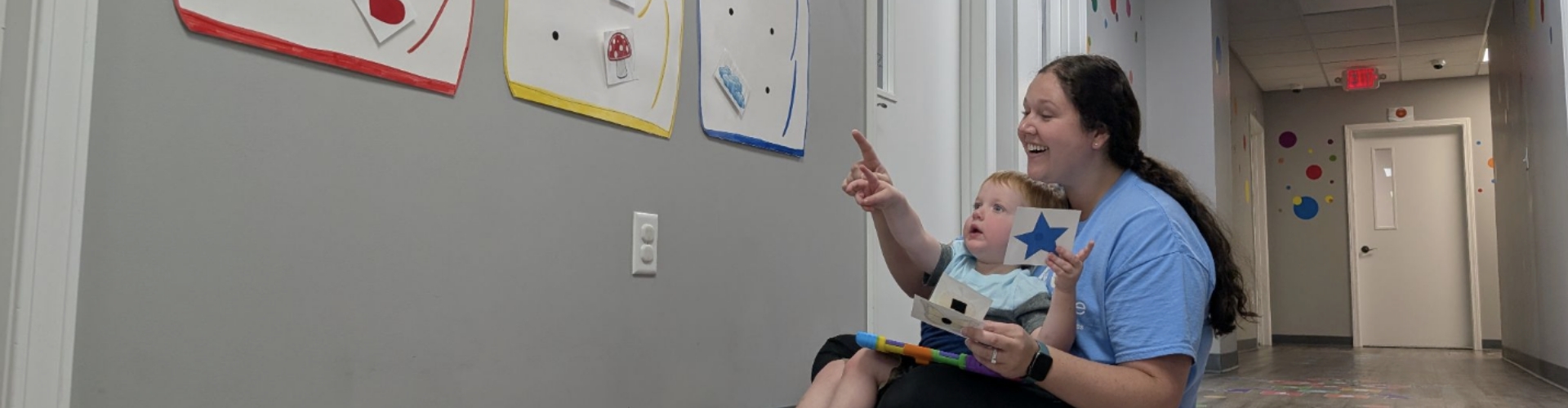
Use cues like pointing or gestures to help your child understand what you are saying.
Encourage Questions
Make sure your child knows it’s okay to ask for clarification or repetition if they didn’t understand or forgot something that was said.
If you are concerned about your child’s language comprehension, call us at 660-219-9176 (Clinton) or 660-219-9381 (Knob Noster) to schedule a speech-language evaluation.